UNIT 2: ROADWAY SAFETY
page 13 of 29Safer Vehicles
 Expand the availability of vehicle systems and features that help to prevent crashes and minimize the impact of crashes on both occupants and non-occupants.
The role of vehicle safety performance in avoiding or mitigating the harm of crashes cannot be overstated. Seat belts and air bags, for example, prevented an estimated 425,000 fatalities in traffic crashes since they were first required through regulatory requirements called the Federal Motor Vehicle Safety Standards (FMVSS).
The next generation of motor vehicles will increasingly have the technology necessary to prevent certain crashes from occurring in the first place and to mitigate harm to those outside of the vehicle when a crash happens. This is particularly important as the proportion of roadway fatalities involving people outside of a vehicle has increased over the past few years.
Deploying Advanced Vehicle Safety Technologies
The deployment of technologies to improve vehicle safety has rapidly accelerated in the last five years. Data from the New Car Assessment Program shows substantial increases over time in the percentage of passenger motor vehicles equipped with advanced driver assistance system technologies.
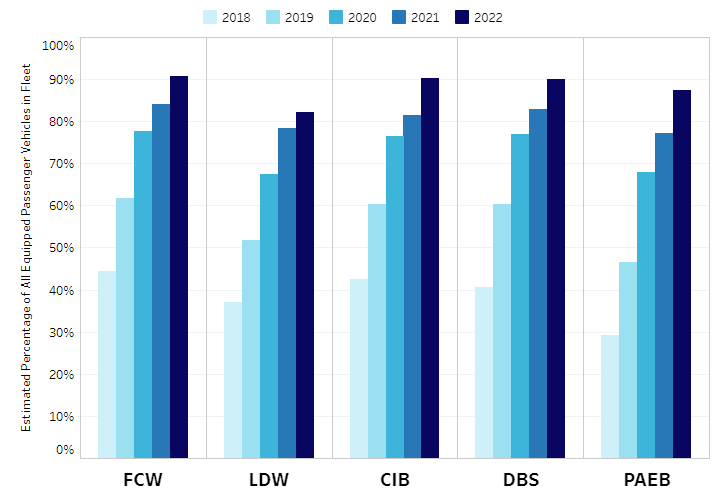 FCW: Forward Collision Warning
LDW: Lane Departure Warning
CIB: Crash Imminent Braking
DBS: Dynamic Brake Support
PAEB: Pedestrian Automatic Emergency Braking
Improving Commercial Motor Vehicle Safety
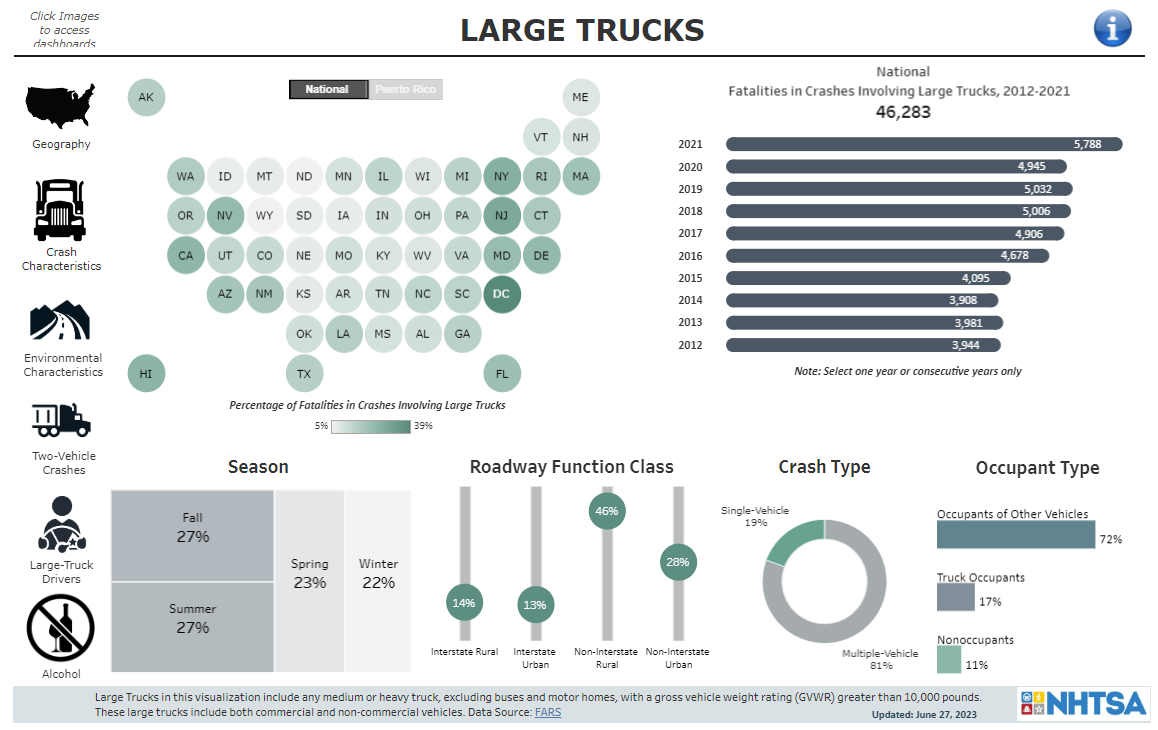
Enabling safer vehicles also means employing strategies to improve the safety of the commercial motor vehicles that transport goods and carry thousands of passengers locally and across the country every day.
The data visualization below focuses on large truck safety.
Through the NRSS, the Department will continue to leverage enhanced motor vehicle safety performance and technologies to improve safety for vehicle occupants and other road users, too.
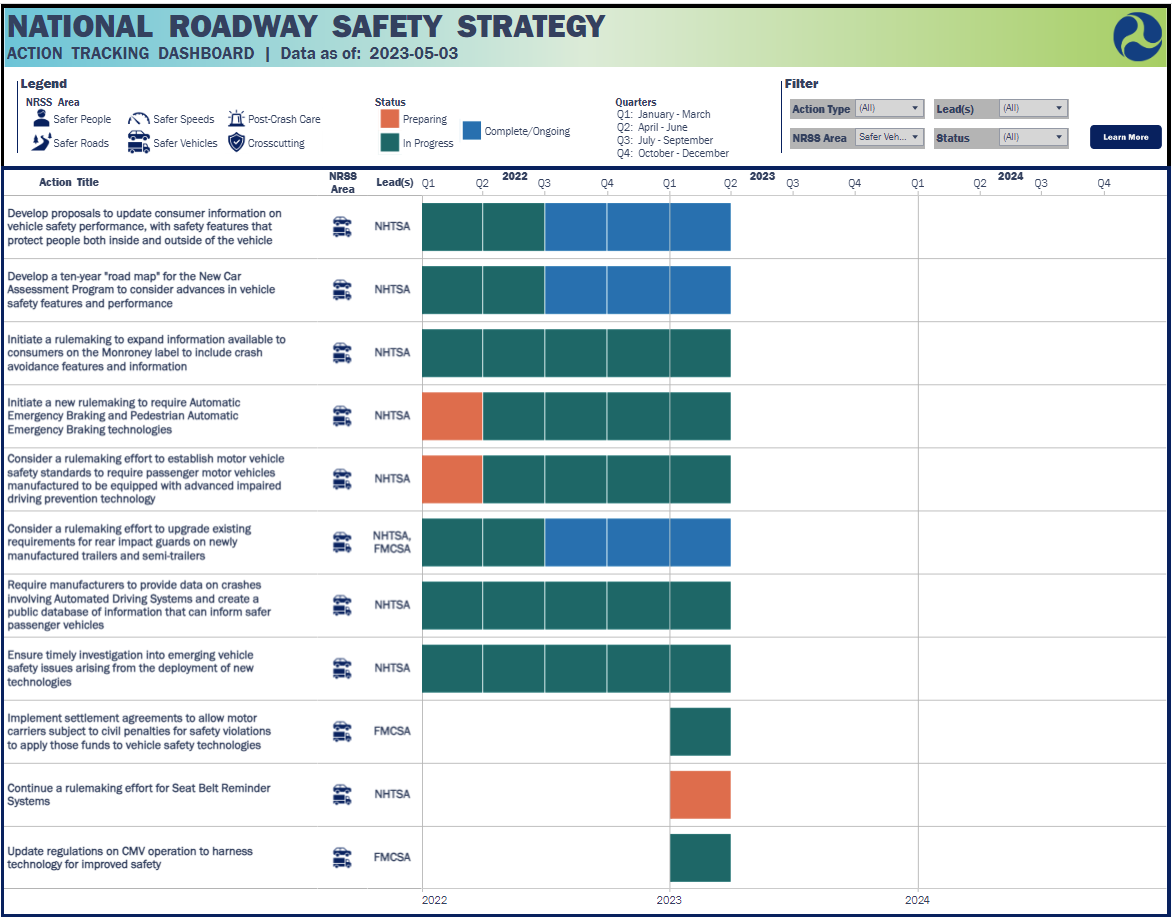
Key Departmental Actions to Enable Safer Vehicles
Safer Speeds
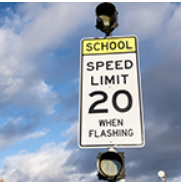 Promote safer speeds in all roadway environments through a combination of thoughtful, equitable, context-appropriate roadway design, targeted education, outreach campaigns, and enforcement.
The Department believes it is important to prioritize safety and moving individuals at safe speeds. Both exceeding the posted speed limit and driving too fast for conditions are speeding-related crash factors.
The Effects of Speed on Roadway Fatalities
Speeding increases both the frequency and severity of crashes, yet it is both persistent and largely accepted as the norm amongst the traveling public. Unsafe speeds are a well-documented and understood factor in death and injury, especially among people outside of a vehicle. Managing speeds and addressing issues of speeding will improve safety.
Impact Speed and a Pedestrian’s Risk of Death
Speeding is a significant contributor to deaths on our roadways and is particularly hazardous to pedestrians. Yet, speeding remains worryingly common.
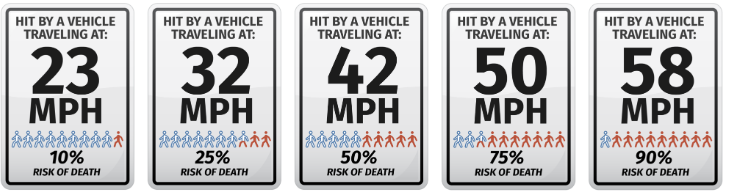
The relationship between impact speed and a pedestrian’s risk of death has been studied extensively; however, past studies of data from the United States are now several decades old. Older studies of data from the United States may not be generalizable to the present situation because of changes in the composition of the walking population, vehicle design, and medical care over the past several decades. Similarly, the ability to generalize from recent European studies to the United States is unclear due to differences in the types and sizes of vehicles driven in Europe versus in the United States.
This study estimates of the risk of severe injury or death for pedestrians struck by vehicles in the United States using data from a federal study of crashes that occurred in the United States in years 1994 – 1998 in which a pedestrian was struck by a forward‐moving car, light truck, van, or sport utility vehicle. The data were weighted to correct for oversampling of pedestrians who were severely injured or killed. Logistic regression was used to adjust for potential confounding related to pedestrian and vehicle characteristics. Risks were standardized to represent the average risk for a pedestrian struck by a car or light truck in the United States in years 2007 – 2009.
Results show that the average risk of severe injury for a pedestrian struck by a vehicle reaches 10% at an impact speed of 16 mph, 25% at 23 mph, 50% at 31 mph, 75% at 39 mph, and 90% at 46 mph. The average risk of death for a pedestrian reaches 10% at an impact speed of 23 mph, 25% at 32 mph, 50% at 42 mph, 75% at 50 mph, and 90% at 58 mph. Risks vary significantly by age. For example, the average risk of severe injury or death for a 70-year-old pedestrian struck by a car traveling at 25 mph is similar to the risk for a 30‐year‐old pedestrian struck at 35 mph.
These results could be used to inform efforts to improve pedestrian safety, for example, by limiting traffic speeds to levels that are unlikely to result in severe injury or death in places where pedestrians and vehicles may encounter one another, creating physical separation of pedestrians and vehicles in places where higher traffic speeds are desired, and developing vehicle‐based systems that detect pedestrians and warn the driver or brake automatically when a collision is imminent.
Sources: Fatality Analysis Reporting System; Early Estimates of Motor Vehicle Traffic Fatalities and Fatality Rate by Sub-Categories in 2020, DOT HS 813 118, June 2021; AAA Foundation for Traffic Safety, National Traffic Speeds Survey III: 2015, DOT HS 812 485, March 2018.